Honda Civic Manual Transmission Fluid: A Comprehensive Guide
Maintaining your Honda Civic’s manual transmission requires the correct fluid for optimal performance and longevity. This guide details fluid types, changes, and crucial maintenance intervals.
Honda Civics are renowned for their reliable manual transmissions, offering drivers a connected and engaging driving experience. These transmissions, however, demand specific maintenance, particularly regarding the manual transmission fluid. Unlike automatic transmissions, manual gearboxes rely on fluid to lubricate gears, synchronize shifts, and protect internal components from wear;
Over time, this fluid degrades, losing its lubricating properties and potentially causing shifting difficulties or even transmission failure. Understanding the intricacies of your Civic’s manual transmission, including its fluid requirements and maintenance schedule, is crucial for preserving its performance and extending its lifespan. Proper fluid selection and timely changes are key to a smooth and enjoyable driving experience.
Why Use the Correct Fluid?
Utilizing the specifically recommended manual transmission fluid for your Honda Civic is paramount to its longevity and performance. Incorrect fluids can lead to significant issues, including premature gear wear and synchromesh failure. The wrong viscosity or chemical composition can hinder smooth shifting, causing grinding noises and difficulty selecting gears.
Furthermore, incompatible fluids may damage seals and other internal components, ultimately leading to costly repairs or complete transmission replacement. Honda’s engineering relies on a fluid formulated to meet the precise needs of its manual transmissions; deviating from this can compromise the system’s integrity and reliability. Always prioritize the correct fluid!
Understanding Transmission Fluid Types
Honda Civic manual transmissions require specialized fluids differing significantly from those used in automatic transmissions. It’s crucial to understand these distinctions. Automatic Transmission Fluid (ATF) is designed for torque converter systems, while manual transmissions utilize gear oil to lubricate gears and synchronize shifting. Within gear oil, classifications like GL-4 and GL-5 exist.
GL-4 fluids are typically recommended for older transmissions with brass or bronze synchronizers, offering milder protection. GL-5 fluids provide enhanced extreme pressure protection but can be corrosive to these materials. Modern Honda manuals generally specify GL-4 or fluids compatible with both, ensuring optimal performance and preventing component damage.
Automatic Transmission Fluid (ATF) vs. Manual Transmission Fluid
The fundamental difference lies in their purpose and formulation. ATF, like Honda ATF DW-1 or ATF 3.1, is designed for hydraulic systems, torque converters, and planetary gearsets found in automatic transmissions. It facilitates smooth gear changes through fluid coupling and pressure regulation.
Manual transmission fluid (MTF), conversely, directly lubricates gears and synchronizers. It requires higher viscosity and extreme pressure additives to withstand the direct metal-to-metal contact. Using ATF in a manual transmission will lead to severe damage due to insufficient lubrication and incorrect friction characteristics, resulting in shifting problems and potential transmission failure.
GL-4 vs. GL-5 Gear Oil
GL-4 and GL-5 are API service classifications for gear oils, differing in additive packages. GL-4 is typically recommended for older vehicles with brass or bronze synchronizers, as GL-5’s additives can corrode these materials. However, many modern manual transmissions, including those in Honda Civics, are designed for GL-5.
GL-5 offers superior extreme pressure (EP) performance and protection against wear, crucial for handling higher loads; Using GL-4 in a GL-5 specified transmission may lead to premature wear. Always consult your Honda Civic’s owner’s manual or a trusted source to determine the correct specification for your specific model year and transmission type.

Recommended Fluids for Honda Civic Manual Transmissions
Selecting the right fluid is vital for your Honda Civic’s manual transmission. Honda Genuine Manual Transmission Fluid is often the best choice, ensuring compatibility and optimal performance. Pentosin offers suitable alternatives, providing reliable lubrication and protection. For enthusiasts, Red Line 75W85 Full Synthetic GL-5 is a high-performance option;
Amsoil Manual Transmission Fluid also presents a robust synthetic choice. Prioritize fluids meeting Honda’s specifications. Using incorrect fluids can cause damage. Always verify compatibility with your Civic’s model year before making a purchase, consulting owner’s manuals or parts professionals.
Honda Genuine Manual Transmission Fluid
Honda’s Genuine Manual Transmission Fluid is specifically engineered for optimal performance and longevity within Honda manual transmissions. It’s formulated to provide superior protection against wear, corrosion, and deposit formation, ensuring smooth shifting and reliable operation. Dealerships are the primary source, with pricing around $8 per quart, though it can vary.
Using this fluid guarantees compatibility, avoiding potential issues caused by aftermarket alternatives. It’s designed to meet the precise requirements of your Civic’s transmission, maximizing its lifespan and maintaining factory warranty compliance. Prioritizing genuine Honda fluid is a smart investment in your vehicle’s health.
Pentosin Manual Transmission Fluid Options
Pentosin offers several manual transmission fluid options potentially suitable for Honda Civics, though careful selection is crucial. Pentosin Automatic Dual Clutch Transmission Fluid is not for manual transmissions, highlighting the importance of verifying compatibility. Pentosin’s dedicated manual transmission fluids are designed to meet GL-4 specifications, often recommended for older Honda gearboxes.
Researching specific Pentosin product codes and confirming they align with your Civic’s model year and transmission type is essential; While a viable alternative to Honda Genuine fluid, ensure the chosen Pentosin product meets or exceeds the required performance standards for optimal gear protection and smooth operation.
Red Line 75W85 Full Synthetic GL-5
Red Line 75W85 is a highly regarded full synthetic GL-5 gear oil often considered for Honda Civic manual transmissions, particularly for those seeking enhanced performance and protection. Its synthetic base provides superior shear stability and temperature resistance compared to conventional gear oils. However, GL-5 fluids contain additives that can be corrosive to yellow metals (brass/bronze) found in some older Honda transmissions.

Therefore, careful consideration is needed. While many owners successfully use Red Line 75W85, monitoring for potential issues and ensuring compatibility with your specific Civic model is vital. It’s often recommended for newer transmissions designed for GL-5 fluids.
Amsoil Manual Transmission Fluid
Amsoil offers several manual transmission fluid options suitable for Honda Civics, known for their high-quality synthetic formulations and robust protection. Their products are designed to withstand extreme pressures and temperatures, ensuring smooth shifting and extended transmission life. Amsoil fluids often meet or exceed industry specifications, providing excellent shear stability and oxidation resistance.
Many Honda Civic owners report positive experiences using Amsoil’s manual transmission fluids, noting improved shift quality and reduced gear noise. It’s crucial to select the appropriate Amsoil product based on your Civic’s specific model year and transmission type, verifying compatibility before use.
Checking Your Honda Civic’s Manual Transmission Fluid Level
Regularly checking your Honda Civic’s manual transmission fluid is vital for preventing damage and ensuring smooth operation. This process involves locating the fill and check plugs, typically on the side of the transmission case. With the vehicle on level ground and the engine warm, remove the check plug and observe the fluid level – it should be level with the plug’s opening.

If the fluid is low, carefully add the recommended fluid type until it reaches the correct level. Always use a clean funnel to avoid contamination. Consistent monitoring helps identify leaks or excessive consumption, potentially averting costly repairs.
Locating the Fill and Check Plugs
Identifying the fill and check plugs on your Honda Civic’s manual transmission is the first step in fluid level inspection. These plugs are usually found on the side of the transmission case, often requiring some maneuvering to access. The check plug is typically larger and may have a dipstick-like extension.
The fill plug is usually nearby, and both are often covered in grime, so cleaning the area can help with identification. Consulting your vehicle’s service manual is highly recommended for precise location details specific to your Civic’s model year, ensuring you access the correct plugs.
Proper Fluid Level Procedure
To accurately check the manual transmission fluid level, warm up the transmission by driving briefly. With the vehicle on level ground, remove the check plug while the transmission is warm, but not hot. Fluid should slowly drip out; if it flows freely, the level is likely correct.
If no fluid emerges, or it drips very slowly, the level is low and needs topping up. Add fluid slowly through the fill plug until it begins to drip from the check plug. Replace both plugs, tightening to the specified torque. Always refer to your vehicle’s manual for specific instructions.
Identifying Fluid Condition – Visual Inspection
A visual inspection of your Honda Civic’s manual transmission fluid provides valuable insights into its condition. Healthy fluid should be a clear amber color. Dark, cloudy, or milky fluid indicates contamination, potentially from water or metal particles, signaling internal wear.
A burnt smell suggests overheating and fluid breakdown. The presence of metal shavings is a serious concern, indicating significant gear damage. If the fluid appears significantly degraded, a complete fluid change is recommended. Regularly checking the fluid’s condition helps prevent costly transmission repairs.
Changing Your Honda Civic’s Manual Transmission Fluid
Regularly changing your Honda Civic’s manual transmission fluid is crucial for maintaining smooth shifting and preventing premature wear. This process involves draining the old fluid and replacing it with fresh fluid of the correct type. It’s a moderately challenging DIY task, but achievable with the right tools and knowledge.
Proper execution ensures optimal lubrication and heat dissipation within the transmission. Neglecting fluid changes can lead to costly repairs. Following the correct procedure and torque specifications is vital for a successful and reliable fluid change.
Tools and Materials Needed
To successfully change your Honda Civic’s manual transmission fluid, you’ll require several essential tools and materials; These include a wrench or socket set to remove the drain and fill plugs, a fluid pump for easier filling, and a drain pan to catch the old fluid.
A torque wrench is vital for tightening the plugs to the correct specification; You’ll also need the appropriate amount of new manual transmission fluid – Honda Genuine is recommended – along with gloves, safety glasses, and potentially a funnel. A jack and jack stands may be needed for access.
Drain and Fill Procedure – Step-by-Step
Begin by warming up the transmission slightly. Locate the drain and fill plugs. Place the drain pan under the drain plug, then carefully remove it, allowing the old fluid to drain completely. Once drained, reinstall the drain plug with a new crush washer, torquing to specification.
Using a fluid pump, slowly fill the transmission with the new fluid through the fill plug until it begins to overflow. Reinstall the fill plug, again torquing to the correct specification. Finally, verify the fluid level by checking for leakage and ensuring proper operation.
Torque Specifications for Drain and Fill Plugs
Proper torque is crucial to prevent leaks and damage. For most Honda Civic manual transmissions, the drain plug requires a torque of 29 lb-ft (39 Nm). The fill plug generally needs a slightly lower torque, around 22 lb-ft (30 Nm). However, these values can vary slightly depending on the specific Civic model year and transmission type.
Always consult your vehicle’s service manual for the exact torque specifications for your particular Honda Civic. Using a torque wrench is highly recommended to ensure accurate tightening. Over-tightening can strip the threads, while under-tightening can lead to fluid leaks and potential transmission issues.
Fluid Capacity for Different Honda Civic Models
Determining the correct fluid capacity is vital for proper transmission function. The 2006-2011 (8th generation) Honda Civic typically requires approximately 2.4 quarts (2.3 liters) of manual transmission fluid. For the 2012-2015 (9th generation) models, the capacity is generally around 2.5 quarts (2.4 liters).
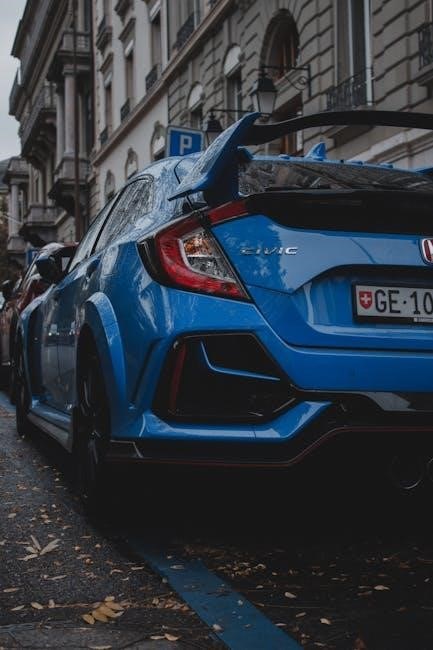
The 2016-2021 (10th generation) Honda Civics usually need about 2.6 quarts (2.5 liters). These are approximate values; always verify the exact capacity in your vehicle’s owner’s manual or a reliable service database. Adding too much or too little fluid can negatively impact transmission performance and longevity.
2006-2011 Honda Civic (8th Generation)
For the 2006-2011 Honda Civic (8th generation) with a manual transmission, using Honda Genuine Manual Transmission Fluid is highly recommended to ensure compatibility and optimal performance. The fluid capacity for these models is approximately 2.4 quarts (2.3 liters). Regular fluid checks are crucial, looking for signs of contamination or low levels.
Owners should prioritize using GL-4 rated gear oil, avoiding GL-5 as it can cause corrosion in some Honda transmissions. A fluid change is typically advised every 30,000 to 60,000 miles, depending on driving conditions and usage.
2012-2015 Honda Civic (9th Generation)
The 2012-2015 Honda Civic (9th generation) manual transmission benefits significantly from Honda’s Genuine Manual Transmission Fluid, maintaining smooth shifting and protecting internal components. This generation typically requires around 2.4 quarts (2.3 liters) of fluid. Consistent monitoring of the fluid’s condition is vital, checking for discoloration or metallic particles.
Like the previous generation, GL-4 gear oil is the preferred choice, and avoiding GL-5 is advisable. A fluid change interval of 30,000 to 60,000 miles is generally recommended, adjusted based on driving habits and severity.
2016-2021 Honda Civic (10th Generation)
For the 2016-2021 Honda Civic (10th generation) with a manual transmission, Honda’s Genuine Manual Transmission Fluid remains the top recommendation, ensuring compatibility and optimal performance. This generation generally requires approximately 2.5 quarts (2.4 liters) of fluid. Regular fluid checks are crucial, looking for signs of contamination or degradation.
Maintaining the correct fluid level and condition is paramount for preventing gear wear and synchromesh issues. Following the recommended 30,000-60,000 mile fluid change interval will contribute to the longevity of the transmission.
Potential Problems with Incorrect Fluid
Using the wrong manual transmission fluid in your Honda Civic can lead to a cascade of problems. Premature gear wear and damage are common consequences, as incorrect fluids lack the necessary additives for proper lubrication and protection. Synchromesh issues, manifesting as difficulty shifting, frequently arise due to inadequate friction modifiers.
Over time, continued use of improper fluid can result in complete transmission failure, necessitating costly repairs or replacement. Prioritizing the correct fluid type – Honda Genuine or a compatible GL-4 or GL-5 fluid – is a vital preventative measure.
Gear Wear and Damage
Incorrect manual transmission fluid significantly accelerates gear wear within your Honda Civic’s gearbox. Without the proper lubricating properties and extreme pressure additives, metal-to-metal contact increases dramatically; This leads to pitting, scoring, and ultimately, the rounding of gear teeth.
The resulting damage compromises the transmission’s ability to efficiently transfer power, causing noise, vibration, and reduced performance. Prolonged neglect escalates the issue, potentially leading to catastrophic failure requiring complete transmission overhaul or replacement – a costly scenario easily avoided with correct fluid maintenance.
Synchromesh Issues
A critical function of manual transmission fluid in your Honda Civic is to facilitate smooth gear changes via the synchromesh system. Incorrect fluid, lacking the necessary friction modifiers, hinders the synchros’ ability to equalize gear speeds before engagement. This results in grinding, difficulty shifting, and a noticeable “notchiness” when selecting gears.
Over time, inadequate lubrication causes increased wear on the synchro rings, diminishing their effectiveness. Continued operation with improper fluid can lead to complete synchro failure, rendering certain gears unusable and necessitating expensive transmission repairs. Maintaining the correct fluid is vital for preserving smooth and reliable shifting.
Transmission Failure
Ultimately, neglecting the proper manual transmission fluid in your Honda Civic can lead to catastrophic transmission failure. Insufficient lubrication accelerates wear on gears, bearings, and other internal components. This escalating friction generates excessive heat, further degrading the fluid and exacerbating the damage.
Severe gear wear creates metal particles that circulate within the transmission, acting as abrasive agents and compounding the problem. Complete loss of lubrication results in welding of gear teeth, seizing of moving parts, and irreversible internal damage. Repairing or replacing a failed transmission is a significantly costly undertaking, easily avoided with regular fluid maintenance.
Compatibility with Other Honda Models
While Honda Genuine Manual Transmission Fluid is specifically formulated for Civic transmissions, it often exhibits compatibility with other Honda models featuring similar manual transmission designs. However, direct substitution isn’t universally guaranteed. Models like the Honda Accord, CR-V, and even older Preludes may be suitable, but verification is crucial.
Always consult your owner’s manual or a Honda dealership parts specialist to confirm fluid compatibility before making any substitutions. Different Honda transmissions may require unique fluid specifications. Using the incorrect fluid, even within the Honda family, can compromise performance and potentially cause damage;
Where to Purchase Honda Civic Manual Transmission Fluid
Genuine Honda Manual Transmission Fluid is readily available through several channels. Your local Honda dealership’s parts department is the most reliable source, ensuring authenticity and expert advice. Online Honda parts retailers, such as HondaAutomotiveParts.com, also offer convenient purchasing options with direct shipping.
Alternatively, major automotive retailers like AutoZone, Advance Auto Parts, and NAPA often stock compatible fluids, including Pentosin and Red Line options. Amazon provides a wide selection, but verify seller credibility. Comparing prices across these platforms is recommended to secure the best deal.
Cost of Manual Transmission Fluid and Service
The cost of Honda Civic manual transmission fluid varies depending on the brand and quantity. Genuine Honda fluid typically ranges from $8 to $12 per quart, while synthetic options like Red Line or Amsoil can cost $15 to $25 per quart. A full fluid change usually requires between 2 to 3 quarts.
Professional service at a mechanic shop generally ranges from $150 to $300, including fluid and labor. DIY fluid changes are significantly cheaper, costing only the price of the fluid and any necessary tools. Consider the time and effort involved when deciding between professional service and a do-it-yourself approach.
DIY vs. Professional Transmission Fluid Change
Performing a manual transmission fluid change yourself can save money, potentially costing only $30-$60 for fluid and a drain plug washer. However, it requires mechanical aptitude, proper tools, and careful adherence to torque specifications. Incorrectly tightened drain plugs or using the wrong fluid can cause damage.
Professional service offers convenience and peace of mind, ensuring the job is done correctly. Mechanics have the expertise and tools to avoid common pitfalls. While more expensive ($150-$300), it minimizes risk and guarantees proper fluid level and torque. Assess your skill level and comfort before deciding.
Long-Term Maintenance and Fluid Change Intervals
Consistent monitoring of your Honda Civic’s manual transmission fluid is crucial for longevity. While Honda doesn’t specify a strict interval, a fluid change every 30,000 to 60,000 miles is generally recommended, especially with spirited driving or frequent towing.
Regular visual inspections for discoloration or metallic particles are vital. Address any leaks promptly. Using high-quality fluid, like Honda Genuine or Red Line, extends fluid life. Proactive maintenance prevents costly repairs and ensures smooth shifting for years to come, safeguarding your transmission’s health.

Frequently Asked Questions (FAQ)
Q: Can I use engine oil in my manual transmission? A: While some suggest it, Honda recommends specifically formulated manual transmission fluid for optimal performance and to avoid potential damage.

Q: What if I can’t find Honda Genuine fluid? A: Reputable brands like Pentosin or Red Line offer compatible alternatives. Ensure the fluid meets GL-4 or GL-5 specifications. Q: How often should I check the fluid level? A: Inspect it during every oil change, and before long trips. Q: Is a flush necessary? A: A simple drain and fill is usually sufficient; flushes aren’t typically recommended.
